Mục lục chuyên đề expand_more
Pressure Equalization Chamber – PEC
In the envelopes of skyscrapers, rainwater leakage does not simply come from open cracks; it is the inevitable result of fluid dynamics when three conditions are present together: (1) Surface water, (2) Gaps in the material, and (3) A driving force (the pressure difference between outside and inside the building).
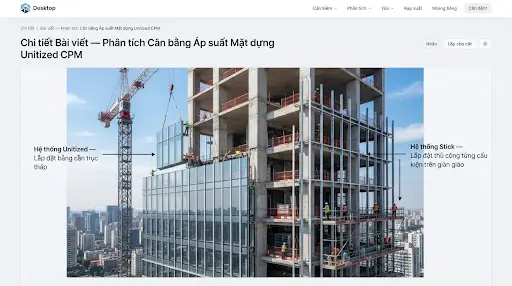
Traditional face-sealed silicone systems (Barrier Wall Systems) often deteriorate quickly after 3 – 5 years due to UV, wind vibration and thermal expansion. That is why the CPM Unitized façade fully applies the principle of Rainscreen & Pressure-Equalized.
Formula for eliminating the penetration force:
When the air pressure inside the cavity (PEC) instantly equals the gusting wind pressure outside the glass, the driving pressure difference ΔP becomes 0. Rainwater on the aluminium ledges loses the energy to travel further inside and falls freely into the drainage channel.
3 Core Water-Stopping Factors on a Unitized Panel
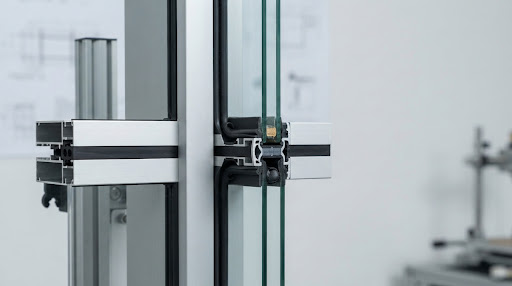
At the junction between the male and female mullions, CPM uses a self-interlocking press connection with no exposed screws. This completely eliminates the risk of tearing the waterproof membrane when the building undergoes story drift under level-7 seismic loads.
Mock-up Test Values
The results below are taken from independent test report no. KĐ-CPM/2025/HN certified by the International Testing Centre:
| Test item | Reference standard | Pressure / Load | Actual result | Status |
|---|---|---|---|---|
| Air infiltration | ASTM E283 / TCVN 9259 | 300 Pa (50 Pa test base) | 0.05 m³/h·m² | EXCEEDS STANDARD |
| Static water penetration | ASTM E331 | 720 Pa (15 minutes continuous) | 0.00 ml (no water leakage) | 100% PASS |
| Dynamic water penetration | AAMA 501.1 (jet propeller) | 1,000 Pa (simulated gusts) | 0.00 ml (no water in inner cavity) | EXCELLENT |
| Structural frame load | ASTM E330 | +3,600 Pa / -3,600 Pa | Deflection L/210 (< L/175 max) | SAFE |
| Seismic drift | AAMA 501.4 | Horizontal displacement ±35 mm | No glass breakage, returns to position | COMPLIANT |